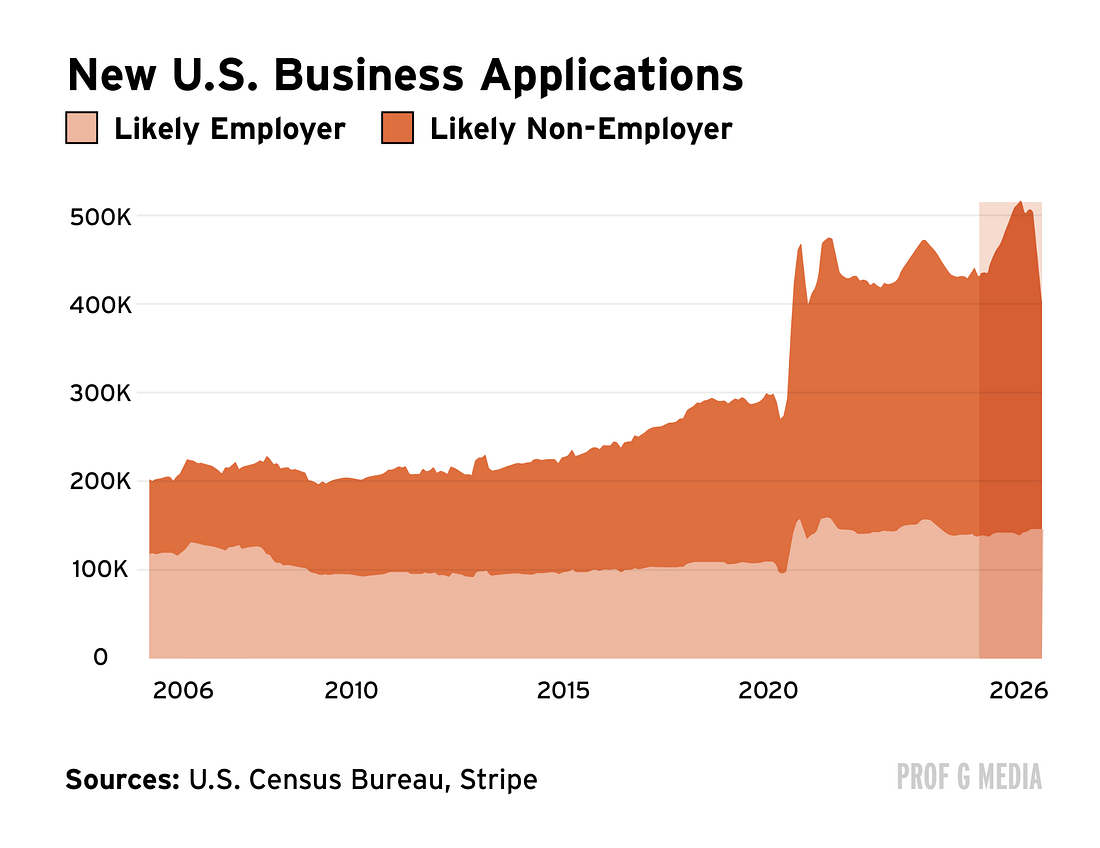
Ed Elson notes that out of 5.7 million new US business applications filed last year, about 70% are classified by the Census Bureau as likely non-employers. He believes it mostly masks fake businesses. This share has doubled over twenty years, while the portion of high-propensity applications expected to create jobs has been cut in half.
Now, one might ask, what’s the point of starting a business without making money from it? In one word: Virtue signaling. The number of Americans adding “founder” to their LinkedIn profiles increased by 69% last year.
But Elson’s data carries a time-horizon trap: over twenty years, the outlook indeed is bleak. Look past the pandemic in 2020, and the picture shifts. As of June 2026, high-propensity applications hit roughly 150,000 a month, about 40% above 2019 levels, and a Richmond Fed analysis from January last year found applications from likely employers rose as much as 49% over pre-pandemic figures.
So, two things can be true at the same time: hobby incorporation is up, but so is real business formation.