Today I watched the OMR-Podcast episode “Deutsches KI-Wunderkind” about Leopold Aschenbrenner from four days ago, where Pip and Noah warned that catching a trend early doesn’t mean you can hold the performance. A few hours later, CNBC reported that Leopold’s fund Situational Awareness sold its entire public book to Citadel.

But he is not wiped out. The fund launched in late 2024 with $225 million and returned 439% net through June, according to the Financial Times. And his private stakes remain, including an Anthropic position bought at around a $60 billion valuation.

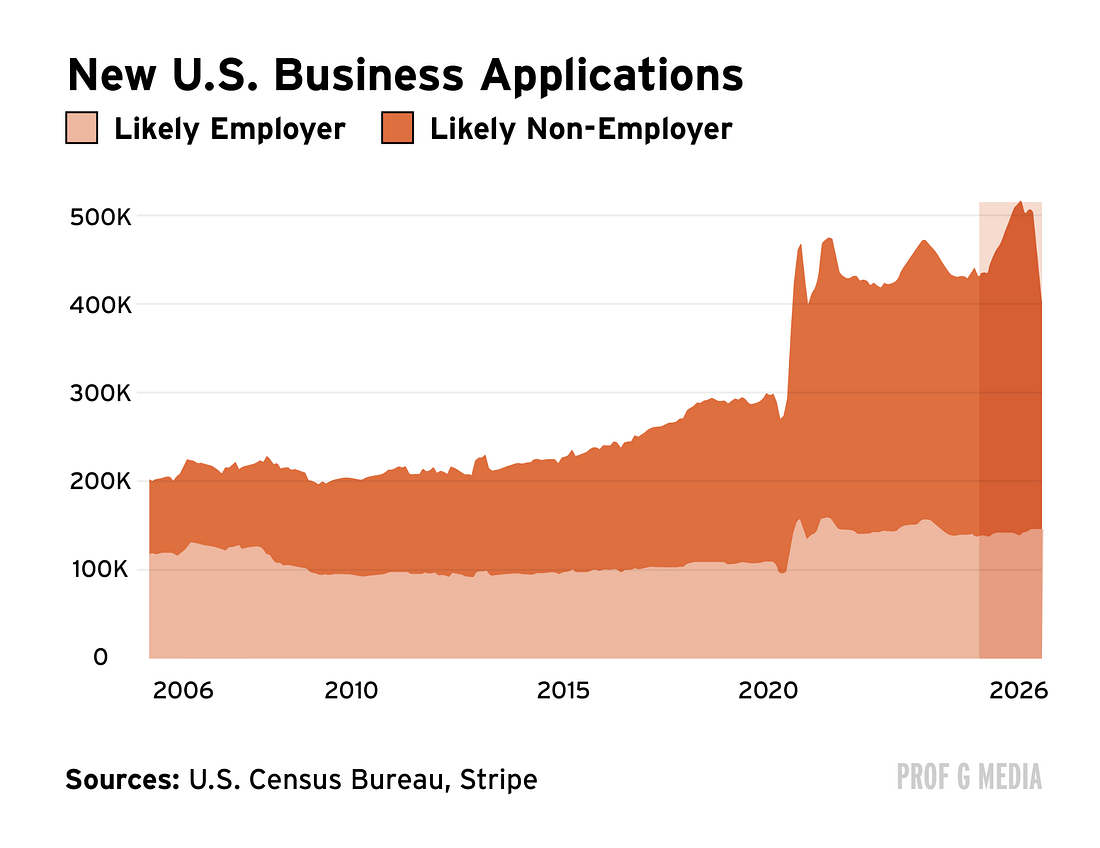
Ed Elson notes that out of 5.7 million new US business applications filed last year, about 70% are classified by the Census Bureau as likely non-employers. He believes it mostly masks fake businesses. This share has doubled over twenty years, while the portion of high-propensity applications expected to create jobs has been cut in half.

Now, one might ask, what’s the point of starting a business without making money from it? In one word: Virtue signaling. The number of Americans adding “founder” to their LinkedIn profiles increased by 69% last year.

But Elson’s data carries a time-horizon trap: over twenty years, the outlook indeed is bleak. Look past the pandemic in 2020, and the picture shifts. As of June 2026, high-propensity applications hit roughly 150,000 a month, about 40% above 2019 levels, and a Richmond Fed analysis from January last year found applications from likely employers rose as much as 49% over pre-pandemic figures.

So, two things can be true at the same time: hobby incorporation is up, but so is real business formation.

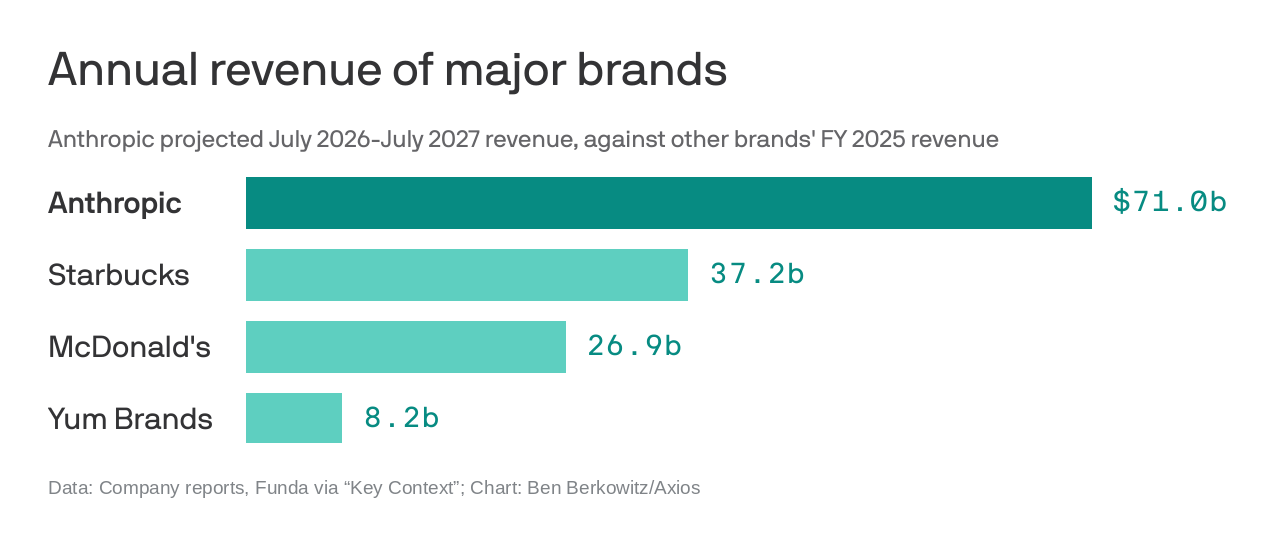
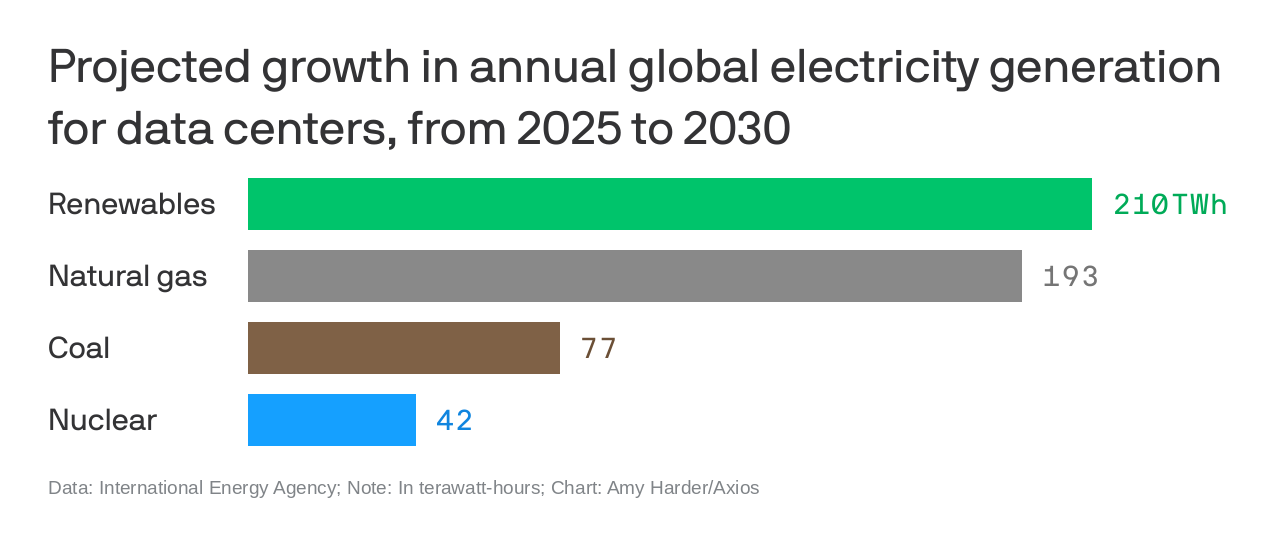
Two charts from Axios show different sides of the current trajectory of AI companies.

Axios chart, annual revenue of major brands: Anthropic $71.0b projected for July 2026 to July 2027, Starbucks $37.2b, McDonald's $26.9b, Yum Brands $8.2b.Axios chart, projected growth in annual global electricity generation for data centers from 2025 to 2030: renewables 210 TWh, natural gas 193, coal 77, nuclear 42.

From the NYT editorial board:

The best policy going forward would be a strengthening of the controls. Regulators should avoid approving any H200 requests unless they become confident that H200 would not strengthen China’s A.I. capabilities. The Trump administration should maintain the ban on Blackwell sales and should extend it to the next generation of chips, known as Rubin.

Ben Thompson has long advocated for releasing the chips while tightening the ban on the equipment that China’s own factories rely on. His Taiwan deterrence case is that selling advanced chips keeps Chinese buyers reliant on TSMC fabs. A China that needs Taiwan’s factories operational has less reason to invade the island.

And Trump indeed approved H200 exports in December 2025. But only a month later, reports emerged that Beijing had instructed its customs authorities to block the chips at the border.

A decade of chip policy assumed China would accept whatever Washington permitted. Beijing showed it can refuse.

Chris Best, CEO of Substack, coined the excellent term Claudefishing to describe the central problem with AI-generated text: readers unknowingly investing their attention in writing that has no human judgment or thought behind it.

John Gruber argues that no AI company will use the Android AI interoperability APIs the European Commission just mandated for Google, just as no 3rd party browser used Apple’s DMA browser engine APIs. His reason: the EU user base is not large enough to justify building a custom web browser, or an AI assistant.

But market size is not the only reason. According to Open Web Advocacy, Apple’s entitlement terms were one-sided and failed the DMA’s own standard of strictly necessary and proportionate. Vendors had to ship a brand-new app for the EU and abandon their entire existing EU user base to do so, which is not commercially viable.

Everything will be determined by Google’s terms.

There was a lot of discussion this week about cheaper Chinese AI models after the release of the new Kimi K3 model. The tech media framed it primarily as the beginning of a price war. That framing seems off.

Ben Thompson’s “Who’s Afraid of Chinese Models?" piece rightfully argues that the correct result matters more than the token. Models burn different amounts of chain-of-thought tokens to reach the same conclusion.

And there might be another reason for the price difference:

Right now there is a price umbrella that is downstream of the lack of compute; I highly doubt that Chinese models are cheaper to serve on a marginal cost basis, they just seem cheaper because Anthropic and OpenAI are so supply constrained that they are charging far more than they would if there were sufficient supply to meet the demand for intelligence.

The researchers Agarwal and Sen ran an interesting field study with 1,065 US Chrome users in January this year. The users had to install an extension toggling AI Overviews off and on. The paper is the first randomized evidence on what this actually means for publishers.

Google’s standing defense has been that AIOs reduce clicks but improve quality of the remaining ones, filtering out low-intent traffic and educating the user with better search results beforehand.

Well…

On queries where AIOs appeared, outbound clicks fell 39.8%. Across all searches, the drop was 18.5%. When AIOs were removed, the recovered clicks showed no quality difference: bounce rates and time on page were unchanged. The traffic from Google was nothing more than ordinary traffic.

Also worth noting: Links within AIOs generated only 7.1% of outbound clicks. Very telling for everyone who is betting on GEO as the next big thing in search marketing.

More than 60 apps passed Apple App Store review while hiding an online gambling platform behind weather icons, maps, and travel games. The front end behaved correctly for reviewers, then switched to a betting UI the moment a Brazilian IP address connected.

As if that weren’t enough, the operators published a playbook on GitHub explaining how to vibecode these apps using a Cursor agent, making the operation look like the work of dozens of independent developers.

But it gets better: Apple’s “You Might Also Like” recommendation engine clustered these apps together and even surfaced them during discovery, grouping scam apps as if they were a genre.

What a massive L for the Apple review team.

On July 14, Apple notified advertisers about an update to its Terms of Service. The old text defined ad properties as covering “Apple software applications or Apple devices.” The new text adds “web applications, or other platforms or properties” and drops the word “Apple.”

Aside from the obvious rumors of an iAd 2.0 network, this changes Apple’s two-tier attribution regime since ATT. Until now, Apple used its own Ads Attribution API for its own inventory (read: ASA) and SKAdNetwork/AAK for everyone else. That asymmetry held while Apple Ads remained on Apple-owned surfaces—App Store, Apple News, Stocks, and Apple TV— with Maps ads arriving this summer.

It collapses the moment Apple Ads appear on a surface Apple doesn’t own. Apple would measure its own ads on your app better than you can measure your own.