Earlier this month, I laid out the contract math on Netflix renewals. Since the costs of casting and showrunning significantly increase from season to season, they prefer producing low-budget, limited-run series.

Eric Seufert did a great follow up with a piece that adds the demand side: Netflix' recommendation engine runs the same calculation. Routing a user to a new series extracts more economic value than returning them to a known one:

A fan who loved Season 1 comes back for Season 2 on their own, so that slot mostly buys a view Netflix would have gotten anyway, whereas the same slot spent on a new title surfaces something the viewer would not have found alone and spreads their attachment across more of the catalog, which means higher incremental engagement and lower churn risk.

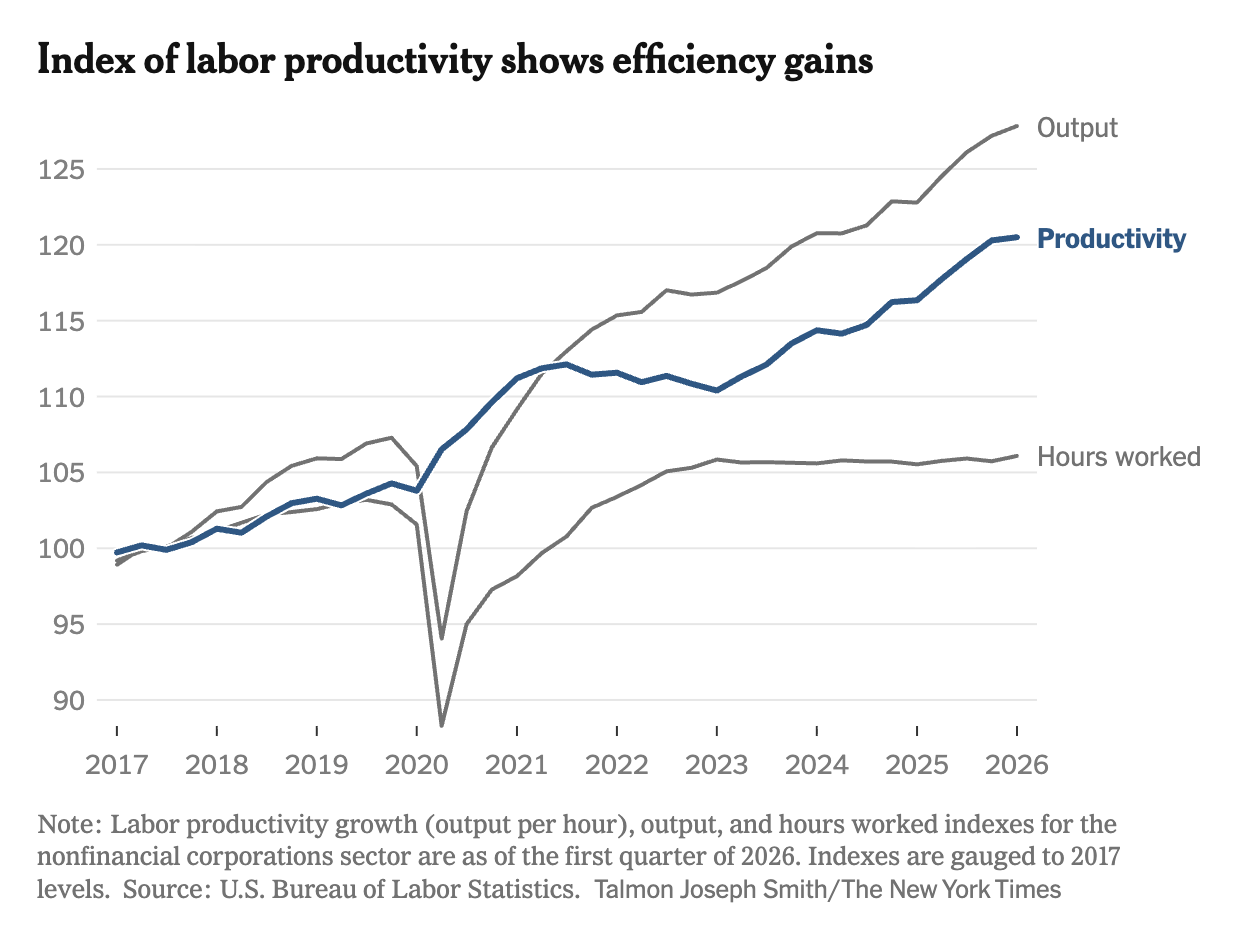
A New York Times analysis published this week adds data to a feeling that I believe many of us already had: over the past decade, US productivity grew at roughly twice the rate of real compensation. Labor’s share of national income sits near a 78-year low. Tech employment contracted for 18 consecutive months. Finance shed more than 100,000 jobs since May 2025. Oil and gas went from roughly 200,000 workers in 2013 to about 115,000 today.

AI advocates tend to skip this step. They cite efficiency, output per hour, leaner operations. While that might be correct, the other side of the coin is fewer people doing more, with the margin flowing to balance sheets rather than paychecks.

Labor productivity, output, and hours worked indexes for nonfinancial corporations show efficiency gains with output and productivity rising steadily from 2017 to 2026 while hours worked remain relatively flat after a sharp drop in 2020.

Wild stat from a recent Marketing Science study: 96% of sponsored tweets carried no disclosure. Other studies found similar rates on YouTube and Pinterest.

To this day, the FTC has never obtained a monetary penalty from an individual influencer for a disclosure violation. The agency mostly targets brands, because policing millions of individual posts is genuinely hard.

And as you’d expect, Generative AI makes this bad situation even worse, with campaign costs approaching zero and fake influencer avatars promoting real products.

In the early days of Growfirst, an app marketing agency I co-founded in 2016, we constantly cited Hopper as a best practice for cutting-edge growth marketing (or growth hacking, as it was called back then). Highly relevant push notifications, perfectly timed permission prompts, and gamification that kept users engaged even when the app’s use case (flight booking) was infrequent.

Then every screen became a nudge. The app grew genuinely unusable because of popups, re-engagement prompts, and ever-new monetization attempts.

Last week’s FTC $35 million settlement is therefore not a big surprise. Companies that treat optimization as the only value follow a predictable arc: growth → saturation → extraction. Hopper followed that trajectory precisely. The gold-standard case study became the cautionary one.

Ryan Broderick’s piece this week frames Netflix’s catalog strategy as deliberate shovelware production, and a Bloomberg report confirms it: Beef’s viewership dropped from roughly 30 million views to 10 million between seasons. Across big titles, the range runs from 30% to over 70%. Netflix describes this as audience behavior. The structure of their contracts explains it more directly.

Cast and showrunner contracts carry built-in raises that spike around the third season, and because Netflix owns its shows outright with no syndication windfall to recoup them, those rising costs never get paid back. Launching a new show resets the acquisition hook, surfaces fresh content for non-subscribers, and avoids the renewal premium.

The platform’s current biggest title is the 13th Harlan Coben adaptation, I Will Find You, a limited series that premiered June 18. Coben adaptations fit the model precisely: cheap to develop, internationally distributable, finite by design. No second-season audience collapse if there is no second season.

Meta got a roughly 10% pop for planning to resell its excess AI compute, a business the market can finally put on a spreadsheet. In contrast to Zuck’s Superintelligence, which seems to lead nowhere. But reselling compute to monetize overbuilt infrastructure is a sign that a company has stopped making the case for its core business. Barely anyone at Meta speaks for the advertising engine that funds it all.

Eric Seufert traces this vacuum to a specific absence:

But I believe that Meta is currently gripped by a strategic morass that prevents it from making a convincing argument that these investments are justified and commercially prudent. I noted in a recent episode of the Stratechery podcast that Meta has a communication problem: Mark Zuckerberg simply refuses to engage with the value of digital advertising infrastructure through either a tactical or conceptual lens. Sheryl Sandberg used to fulfill that role: she would articulate the value that Meta provided to its 10MM advertisers on each earnings call, making the case that Meta’s advertising platform is especially powerful for small businesses. But beyond that, she would meet with customers, large and small; I know dozens of CMOs and marketing leaders who have taken pictures with her over the years. No Meta executive occupies that role now.

In Q1 2026, library titles drew roughly 25 billion streaming hours against 7.3 billion for originals. More than 75% of all streaming time was spent on catalog content such as Friends, Suits, and Modern Family.

Strip out Netflix and the catalog share climbs even higher to roughly 90%. Netflix is the only major streamer where originals nearly match catalog viewing, and the reason is simple: more than $135 billion in content spend over the past decade, with roughly $20 billion projected for 2026 while rivals cut.

Bei fast allen großen Streaming-Plattformen dominiert alter Inhalt die Betrachtungszeit gegenüber Originalinhalten.

A University of Chicago study surveyed 338 students. 60% admitted to using AI in their own coursework, while 90% reported that their peers did. People disclose what they judge acceptable to admit about themselves.

Classic social-desirability bias.

According to an internal OpenAI study, a quarter of Codex users now delegate 8+ hour tasks, up from 2% a year ago. But fewer than 1% of individuals use Codex at all. Inside OpenAI, 99.8% of work runs through it.

This is them measuring themselves, not the market.

4 in 5 under-16s in Australia are still on social media, three months after the ban.

A BMJ study found most were verified by selfie or a typed age. Almost none were asked for real ID.

What a farce. The UK will be next in 2027.