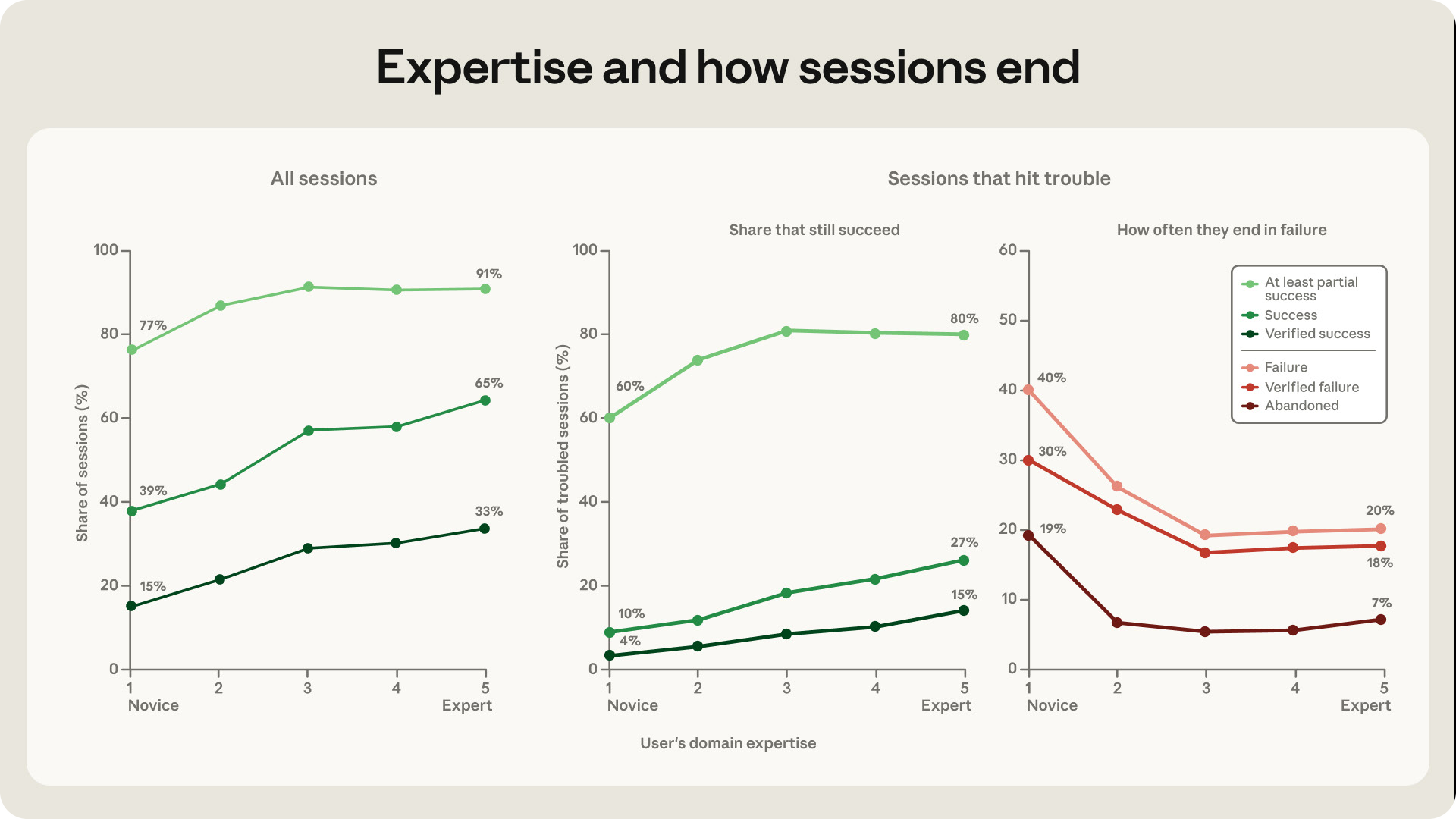
An Anthropic study on agentic coding sessions found that experienced users completed working, verified solutions at twice the rate of novices: 28-33% versus 15%.

The gap comes from how they prompt. Experts issued 12 actions per session and wrote around 3,200 words. Novices only issued 5 actions and wrote around 600. More prompts and longer ones mean more precise specifications and more course corrections along the way. Producing more output by itself is not the win. Directing the agent with better detail is.

The deciding factor is domain knowledge, not coding skill. You need to know what a good result looks like in order to steer toward it.

Figure 5: Expertise and how sessions end, from the Anthropic study

SemiAnalysis puts the compute each Claude Max subscriber actually burns at $8,000 of API list-rate tokens, and Codex users closer to $14,000. Although serving costs are roughly a quarter of the list price, the actual loss per plan amounts to a few thousand dollars. Still a serious burn rate.

But every Max session produces a detailed record of how people work through real problems, the kind you cannot get just by buying tokens. Anthropic recently extended 30-day data retention to accounts that previously kept nothing. This kind of data only gets more valuable and harder to get.

Four companies just wrote a $1BN check into AppsFlyer. Meta, Google, Unity, and Moloco do not commit that kind of capital to a neutral third-party MMP unless they have come to one conclusion: Apple’s own attribution framework is dead.

Five years ago, Apple forced the ecosystem onto SKAN under the threat of ATT. Companies spent millions rebuilding measurement around a framework they had no hand in designing. Then Apple suddenly stopped all communication around it. Apple quietly replaced SKAdNetwork with AdAttributionKit as the named successor in 2024, and this year’s WWDC passed without a single update to it.

No roadmap, no deprecation notice for what it replaced.

Drew Gooden’s The Music Industry is Broken video is the best breakdown of how Spotify and other music streaming services pay artists so poorly, and why AI makes an already bad situation even worse.

Spotify doesn’t pay a per-stream rate. It pays by streamshare: a fixed monthly pool of subscription revenue, divided according to each rightsholder’s proportion of total streams.

Every new track added is another claimant on the same money. Flood the catalog with cheap functional tracks or AI-generated filler, and individual artists' payouts shrink even if their own stream counts hold steady.

Well, unfortunately, that means that at the end of the month, about 99% of your subscription revenue has contributed to a bunch of anonymous, faceless stock music that you weren’t even awake to hear. And the remaining 12 cents goes to your favorite band.

The money flows toward whoever controls the volume: major labels, playlist curators, Spotify’s own commissioned content. Spotify’s margin improves because the filler costs almost nothing to license.

But that’s not it. Introducing: Discovery Mode. Artists can pay for visibility on the same platform that just diluted their payout. The fee is a 30% royalty cut. Spotify created the problem to sell the solution.

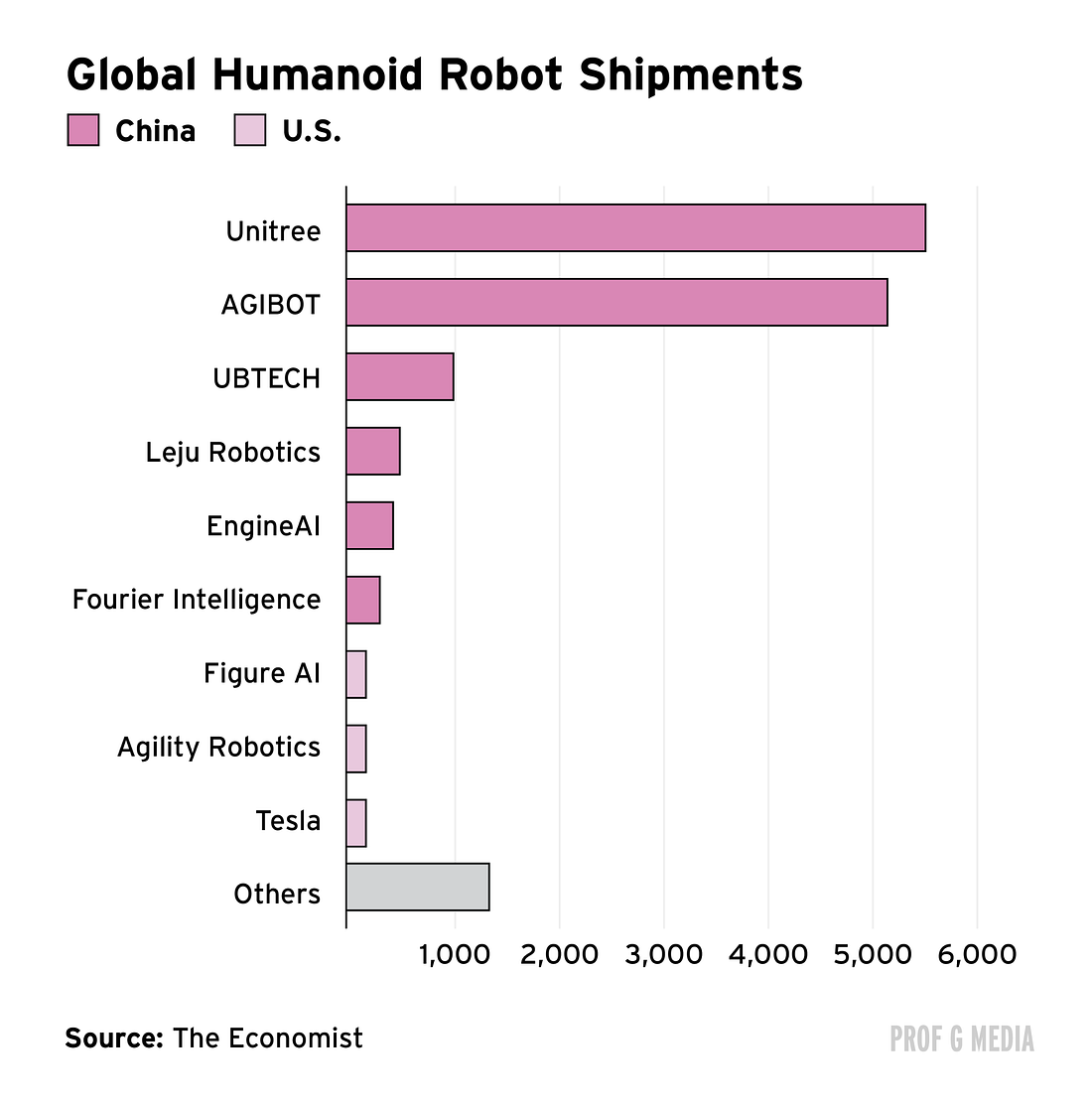
Alice Han and James Kynge’s China Decode newsletter makes a case that most coverage of the AI race gets wrong. The real contest is physical, and China is already ahead:

I’ve long believed the AI race extends well beyond generative AI and large language models. That’s certainly the way China sees it. While the private sector in the U.S. spends 12 times as much on computing power, China spends 42% more on robotics, a gap that’s only going to widen. Where AI and robotics intersect, China has an edge.

China now produces roughly 90% of the world’s humanoid robots. At the same time, China’s NDRC has flagged a domestic bubble. More than 150 robotics makers are active, most operating at Level 0 or 1, running scripted actions or teleoperated demos.

Both things are true. A structural lead built on factories that can repoint to robotics, and a manufacturing culture built for scale, does not require every startup to survive.

Two weeks ago, the Landgericht München I ruled that Google’s AI Overviews constitute Google’s own content. The decision classifies Google as “unmittelbarer Störer,” a direct infringer, and strips away the liability shield that protects traditional search engines from third-party content claims. Google can no longer argue it simply aggregates what others wrote. This could be a big deal.

In the first four months of 2026, 68 percent of Google searches ended without a click. AI Overviews now run on more than 20 percent of searches and cut clicks by nearly 60 percent when they appear.

Not every jurisdiction sees it this way, however. In Walters v. OpenAI (Georgia, 2025), a defamation claim was dismissed after the court found that no reasonable person would treat a chatbot response as fact. Google’s legal team likely expected the same logic to prevail in Munich. It did not.

It is worth noting that an appeal remains open, but it signals that at least some courts may treat AI-generated summaries differently than search results going forward.

David Pierce, writing for The Verge:

Still, there is something about Shortcuts that feels like a model for implementing AI. It’s not flashy or overwrought, and it’s not AI as an entirely new revolutionary interface that will change how you do everything forever and just trust me bro AI is the new UI. It’s not trying to be creative or proactive, it’s there to do what AI actually does well: figure out what you’re asking for and navigate the databases to try and make it happen.

These natural-language shortcuts are effectively just vibe-coding projects, which is slightly ironic, given Apple’s apparently hostile stance toward the vibe-coding apps on its platform. But rather than let you vibe-code an app, Apple’s just letting you vibe-code your phone. You tell it how you’d like it to work, and it sets out to make it happen. And because Apple has unique access to everything from your location to your app logins, it can do so in a vastly more powerful way.

I disagree on the vibe-coding part. Apple built this on App Intents, the framework developers already use to connect their app workflows with Siri. The AI layer sits on top and translates plain-English requests into structured calls that the system already knows how to execute. That constraint is a feature, not a bug, because the model cannot hallucinate an action that App Intents doesn’t support.

AI with a defined scope might prove more useful to us than AI promising to replace every interface we have.

Apple released a major update to its Foundation Model Framework (FMF) which enables app developers to integrate advanced AI models in 3 ways:

  • Apple’s smaller on-device models
  • Apple’s larger models in the privacy-safe PCC environment
  • Routing to the externally hosted Claude or Gemini models

But the latter needs consent, which will disincentivize their usage due to possible low opt-in rates.

Eric Seufert speculated back in February that it could also be a monetization opportunity for Apple:

A more pertinent question is, perhaps: if Apple is able to dissuade developers from utilizing third-party AI services through the consent requirement, but accessing models hosted via PCC does not require consent, will Apple be able to charge a revenue share for “default AI status” at some point, as it does with default search engine status in Safari?

Put another way: if the only way to host a model in PCC is to enter into some sort of partnership with Apple, could Apple charge a revenue share on API-based token usage for the frontier models it allows into its PCC environment? Apple currently pays Google for the privilege of using Gemini, but I imagine that it’d prefer that money flow in the other direction. Apple may be setting the stage for a revenue opportunity in in-app AI usage by creating a consent distinction between models hosted via PCC through a partnership with Apple and those that aren’t.

This approach differs from five years ago when Apple only destroyed the market value of Meta and other ad networks by introducing ATT.

While they also provided publishers with a workaround around SKAN limitations by using their own ASA network, they did not secure the majority of marketing budgets because ASA was (and still is) challenging to scale in most categories.

Perhaps Apple can capitalize on its gatekeeper position more effectively this time.

Not much is new for app marketers from this year’s WWDC. However, Apple will finally follow Meta’s and Google’s lead and allow us to upload our own creatives for Apple Ads. Independent of the App Store product page:

  • Images and videos must use a 3:2 aspect ratio.

  • Videos must be between 5-30 seconds in length and can only be used in search results ads.

  • Videos can be uploaded with or without audio, but audio will not play.

  • Images and videos can include embedded text, and you can localize the text according to the countries and regions where your ads will run.

As always, Apple’s guidelines on this are quite vague. It remains to be seen how far marketers will push the limits, as Apple stays very protective of the content shown in its App Store.

Ed Elson on his newsletter Simply Put:

For years, stock prices have remained elevated, partly due to unusually low supply. The IPO market essentially collapsed after COVID. The number of public companies is half what it was 30 years ago.

This made investing quite easy, as all you had to do was keep investing in the companies that already existed. (Read: Big Tech.) The virtuous cycle of low supply and high demand drove the price of tech stocks ever higher, making them, on a risk-adjusted basis, arguably the greatest asset class in history.

But that’s all about to change, and violently so. SpaceX, Anthropic, OpenAI, and Google are about to inject roughly $350 billion of new equity into the market. That’s more money than the entire US venture capital industry invested last year, and more than was raised in IPOs over the past seven years combined. And that’s just four companies.⁠⁠

He presents a compelling argument suggesting that the stock market could enter a downturn due to investors rushing to buy these mega IPOs while withdrawing their money from other companies because they lack the necessary liquidity.

And he’s not wrong, as this has indeed happened in the past with the Xerox or Apple IPO, although with little to no long-term impact.